
On This Page
Imagine a small software company with $120,000 in the bank. It collects $12,000 this month and pays $20,000. The $8,000 gap is real. So is the chance that receipts grow before the account empties.
This is an illustrative company, not Tajo’s accounts or a reported customer. Its numbers expose a question that a single “months of runway” figure hides: which line crosses first, receipts or zero cash?
The original default-alive question asks whether a company reaches profitability on the money already in the bank, assuming recent revenue growth continues and expenses remain constant. A short ingested explanation draws the useful distinction between being profitable today and getting there before cash runs out. Our example models the related cash question, because money received and revenue recognized can arrive in different months.
It is a conditional question. The condition is doing the work.
The crossing point has two coordinates
Profit compares revenue earned with expenses incurred under accounting rules. Cash-flow break-even compares money received with money paid. A runway calculation follows the bank balance through successive periods. A company can spend more cash than it collects today while its balance funds the gap until receipts catch up.
For the illustrative company, hold payments at $20,000 a month. Set receipts for month one at $12,000 and increase them by five percent before each later month. Pay the difference from cash. The model reaches month twelve, when receipts exceed payments, with roughly $71,000 still in the bank. Its lowest balance before that crossing is about $70,000.
Change only the growth assumption to one percent. Cash turns negative before receipts catch up. The starting company is identical. The story is not.
| Illustrative receipts growth | What the simple monthly model shows |
|---|---|
| 0% | Cash reaches exactly zero at the end of month 15; it cannot fund month 16 |
| 1% | Cash runs out during month 18 |
| 2% | Receipts exceed payments in month 27; the lowest prior balance is about $4,000 |
| 5% | Receipts exceed payments in month 12; the lowest prior balance is about $70,000 |
These figures use monthly receipts as cash received, fixed monthly payments, no debt service, no tax changes and no new financing. They are calculated examples, not a forecast. Even the two-percent path leaves almost no room for a delayed invoice or unexpected bill.
Cash balance (USD)
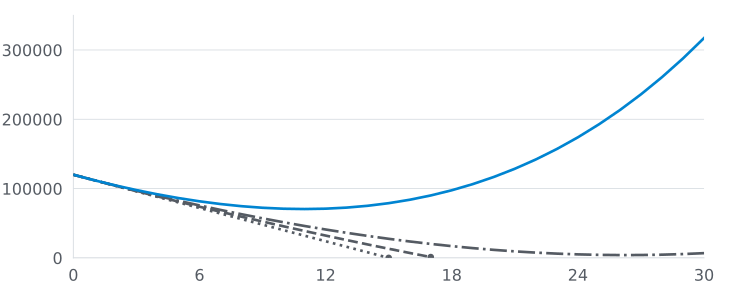
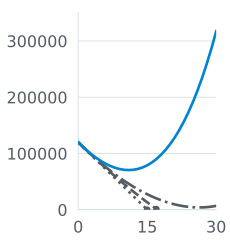
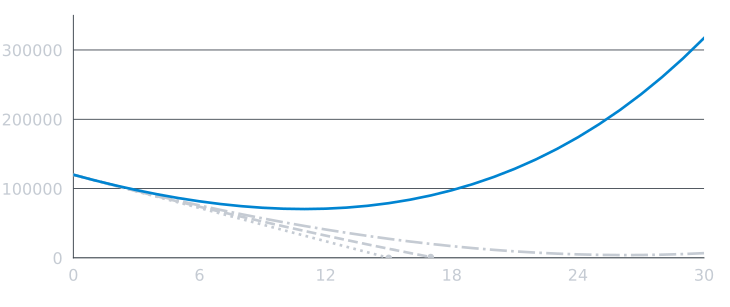
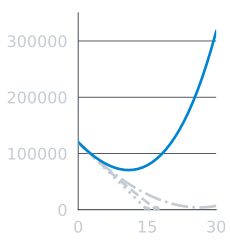
Month (zero is the opening balance)
- 0% monthly receipts growth
- 1% monthly receipts growth
- 2% monthly receipts growth
- 5% monthly receipts growth
Read the calculated balances
| Month | 0% growth | 1% growth | 2% growth | 5% growth |
|---|---|---|---|---|
| 0 | 120,000 | 120,000 | 120,000 | 120,000 |
| 6 | 72,000 | 73,824 | 75,697 | 81,623 |
| 12 | 24,000 | 32,190 | 40,945 | 71,006 |
| 15 | 0 | 13,163 | 27,521 | 78,943 |
| 18 | Funding needed | Funding needed | 16,948 | 97,589 |
| 24 | Funding needed | Funding needed | 5,062 | 174,024 |
| 30 | Funding needed | Funding needed | 6,817 | 317,266 |
Each line stops at its last nonnegative month-end balance. The zero-growth path reaches zero at the end of month fifteen; the one-percent path cannot fund month eighteen. The table marks later unfunded months rather than implying that the company can operate with negative cash. In a real business, payment terms, credit and obligations would change the boundary.
Notice the order of events: a company can have growing receipts in every row and still run out of money. Growth is a rate, while a bank balance is a stock. The rate has to change the stock soon enough. That timing is the entire question.
The blunt verdict is that a line crossing above zero is not comfort. It is a request to inspect the assumptions underneath it.
Static runway answers a different question
“We have fifteen months of runway” can be useful shorthand. At an unchanged $8,000 monthly gap, $120,000 divided by $8,000 is fifteen months. The arithmetic is clean because it freezes the business in place.
Businesses do not hold still. A growing customer base can increase receipts and support costs together. A large invoice might be booked as revenue this month and paid next quarter. Annual contracts can bring cash forward, then leave a thin month later. A team can delay hiring, or an infrastructure bill can climb with usage.
That is why the rows should track cash received, cash paid and ending cash separately. SCORE’s financial projection guide recommends building scenarios around estimated income, expenses and cash flows, then documenting the assumptions. Its cash-flow template also separates when sales are made from when customers pay.
The objection is fair: “A forecast is fiction. Why spend time making one?”
Because a model lets you see which assumption would have to be true. It gives a team a point to test next month. It does not make the assumption true.
Use the model as an alarm, not a promise
Build a monthly table from the actual bank balance. List money likely to arrive, when it can arrive, and money already committed. For uncertain receipts, make a slower case. For expenses, include obligations that do not vanish when a project slips.
Then compare each month with the last actual month. If receipts missed by $3,000, update the next row. If a vendor changed terms, update the payment date. A beautiful curve that never meets the bank statement is decoration.
The same discipline applies to a tool purchase. Our tool ROI framework asks for total cost and a baseline before claiming value. A connector subscription may save manual work, but that saving belongs in the cash model only when the work truly disappears or creates receipts. The free-to-paid decision guide asks a narrower purchase question; neither guide can tell you whether the company survives its next cash gap.
There is one useful decision the chart can force. If the slower case runs out of cash before the business becomes self-funding, the team must change a variable while it still has room to act: cost, price, collections, sales growth or funding. The model cannot choose which move is right. It can make the cost of waiting visible.
Today’s cash gap is a fact. Tomorrow’s survival is a testable set of conditions. Keep the two on the same page.
Frequently Asked Questions
Can a company spend more cash than it collects now and still survive without new funding?
Yes, under a set of assumptions: monthly cash receipts must reach cash payments while the balance remains positive. Model receipts, payments and ending cash. Profitability is a separate accounting measure.
What makes a runway projection unreliable?
Growth, payment timing and costs can change. Show assumptions and slower-growth cases, update the model with actual results, and keep a cash cushion rather than treating a crossing point as a guarantee.
Is runway the same as months of cash at today's burn rate?
No. Dividing cash by current monthly burn is a useful static snapshot. A cash-flow projection shows how receipts and payments might change month by month. Both are estimates, not promises.