
On This Page
A sales pipeline tool is where deals live between “interested” and “closed.” It tracks each opportunity through stages, reminds reps what to do next, and shows leaders where revenue is stuck. Get it right and your forecast becomes trustworthy. Get it wrong and your team quietly goes back to spreadsheets.
The market in 2026 has split into two camps. Lightweight pipeline-first CRMs focus on speed and clean deal management for small and mid-size teams. Heavier platforms bundle the pipeline into a full revenue suite with marketing, support, and automation. Below are the eight tools worth shortlisting, with current pricing and the trade-offs that actually matter when you commit a team to one.
How we picked them
We weighed five things: how fast a rep can move a deal through the pipeline without friction, the depth of automation and reporting, pricing for a small-to-mid team, the quality of the free tier or trial, and how cleanly the tool connects to the rest of your stack (email, e-commerce, and marketing). Prices are USD and approximate as of May 2026, and most vendors quote the annual-billing rate, so monthly billing usually costs more.
What changed in 2026
Two shifts stand out this year. First, AI moved from an upsell to a baseline expectation. Deal scoring, next-step suggestions, and call summaries now appear even on entry tiers from Pipedrive, Zoho, and Freshsales. Second, buyers are pushing back on the gap between a cheap entry seat and the plan that actually unlocks automation. Several vendors restructured tiers in early 2026, and the real cost of a usable plan is often a level or two above the headline price.
The 8 best sales pipeline tools in 2026
1. Pipedrive
Best overall for small and mid-size sales teams.
Pipedrive was built around the pipeline first, and it shows. The drag-and-drop board is fast, the activity reminders keep reps honest, and the learning curve is short enough that a new hire is productive in a day. After an early-2026 restructure, plans run from roughly $14 per user per month at the entry tier up to around $99 for Enterprise, with most teams landing on a mid tier near $49 to $59 for automation and richer reporting. AI deal assistance is now spread across plans rather than locked behind the top tier.
2. HubSpot
Best free CRM that grows with you.
HubSpot’s free CRM gives you a real pipeline, contact records, and basic deal tracking with no time limit, which makes it the easiest place to start. The catch is the climb: Sales Hub paid tiers and the Professional and Enterprise suites escalate quickly, with Professional often quoted in the hundreds per month once you add marketing. If you expect to unify sales, marketing, and support on one platform over time, the upgrade path is smooth. If you only need a pipeline, you may be paying for breadth you will not use.
3. Salesforce
Best for large or complex sales organizations.
Salesforce remains the default for enterprises that need deep customization, territory management, and a vast ecosystem of integrations. Sales Cloud pricing climbs through tiers that reach roughly $165 per user per month and higher for Unlimited, before add-ons. The power is real, and so is the implementation cost. For a five-person team it is overkill; for a 200-rep org with custom processes and a dedicated admin, it is hard to beat.
4. Zoho CRM
Best value inside a broader business suite.
Zoho CRM delivers a capable pipeline, workflow automation, and an AI assistant at a fraction of the price of the enterprise leaders, with tiers commonly running from around $14 up to roughly $52 per user per month. The real advantage is the surrounding Zoho ecosystem (mail, books, desk, campaigns) for teams that want one vendor across the business. The trade-off is a busier interface and a setup that rewards patience.
5. monday CRM
Best for visual, work-OS style teams.
monday CRM is built on the company’s flexible work-OS, so the pipeline is highly visual and customizable, and it sits naturally alongside project boards. Pricing typically starts near $12 to $15 per user per month and rises with automation and seat count. It suits teams that already think in boards and want sales to live next to their other work, rather than teams that need a deep, sales-specific feature set out of the box.
6. Freshsales
Best AI-assisted pipeline at entry pricing.
Freshsales (from Freshworks) pairs a clean pipeline with built-in AI scoring and a usable free tier, and paid plans tend to undercut the bigger suites, often landing well below comparable HubSpot Sales tiers. It is a strong pick for SMBs that want contact-based pricing, built-in phone and email, and AI assistance without paying enterprise rates. Reporting is solid if not as deep as Salesforce.
7. Close
Best for high-volume calling and SMS-driven sales.
Close is built for inside sales teams that live on the phone. Calling, SMS, and email are native, so reps work the pipeline without bouncing between tools, and the built-in dialer and sequencing speed up outreach. Pricing generally starts in the $25 to $35 per user per month range and rises with seats and features. If your motion is high-velocity outbound, Close removes more friction than a general CRM.
8. Brevo
Best when sales and marketing share one contact database.
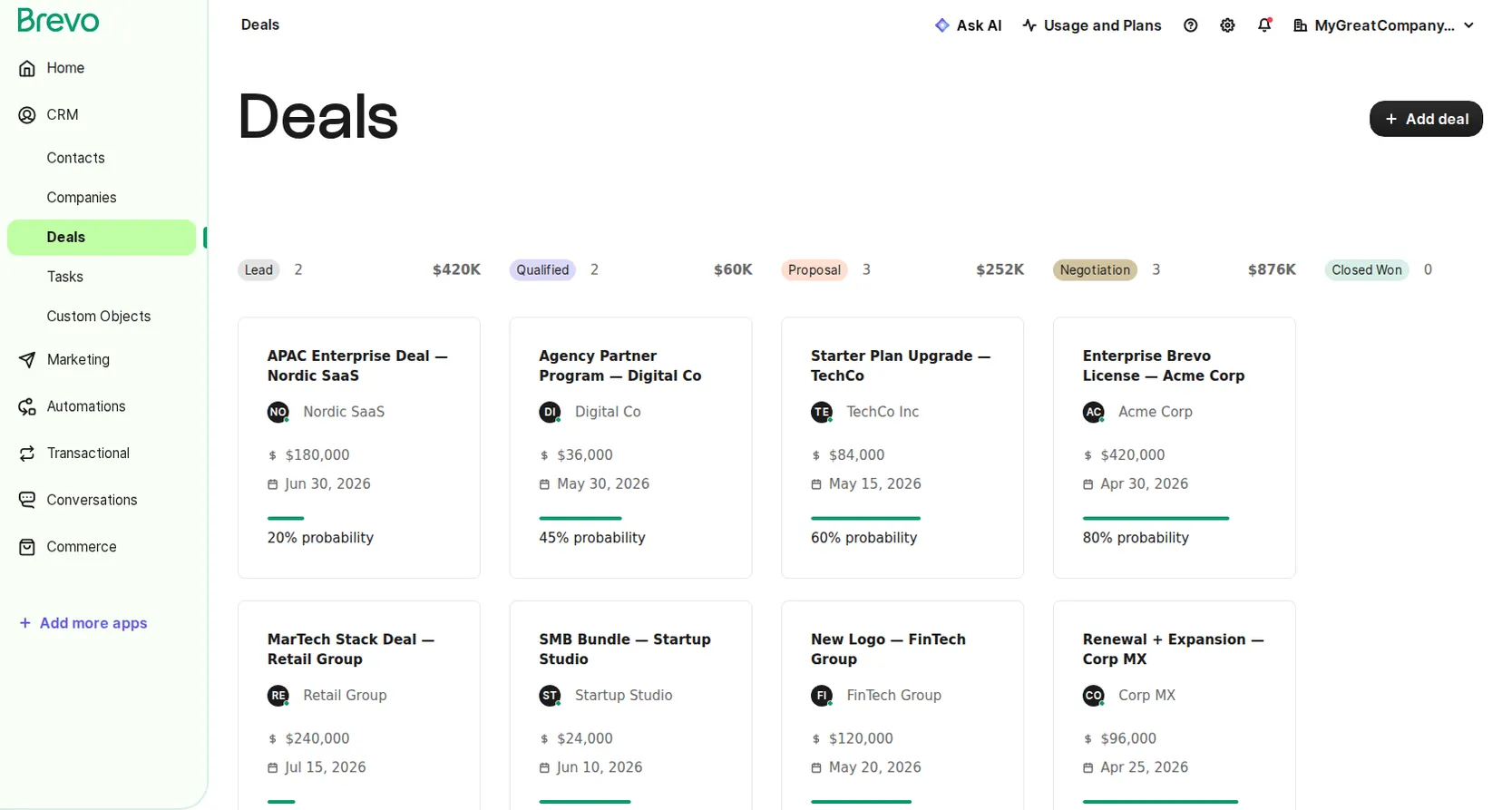
Brevo includes a sales pipeline alongside its email, SMS, and WhatsApp marketing, so a lead captured by a campaign and a deal worked by a rep live on the same contact record. There is a free CRM tier, and paid sales and marketing plans are priced for SMBs rather than enterprises. For e-commerce and small businesses that want the pipeline and the outreach in one place (and that connect to Shopify), it removes the usual sync headaches between a standalone CRM and a separate marketing tool.
Brevo
Quick comparison table
| Tool | Best for | Free tier | Starting paid (approx.) |
|---|---|---|---|
| Pipedrive | SMB sales teams, ease of use | Trial | ~$14/user/mo |
| HubSpot | Free CRM that scales | Yes | Free, then climbs fast |
| Salesforce | Large or complex orgs | Trial | ~$25/user/mo and up |
| Zoho CRM | Value inside a wider suite | Yes | ~$14/user/mo |
| monday CRM | Visual, work-OS teams | Trial | ~$12/user/mo |
| Freshsales | Cheap AI-assisted pipeline | Yes | Low-cost paid tiers |
| Close | High-volume calling teams | Trial | ~$25/user/mo |
| Brevo | Shared sales + marketing contacts | Yes | SMB-friendly paid plans |
The headline price is not the price you pay
Published list pricing per seat. The bar spans a vendor's entry tier to its highest published tier — the gap is the part buyers underestimate.
Values
| Tool | Entry | Top published | Notes |
|---|---|---|---|
| monday CRM | $12 | Not published | entry band $12–$15 |
| Pipedrive | $14 | $99 | most land near $49–$59 |
| Zoho CRM | $14 | $52 | |
| Close | $25 | Not published | entry band $25–$35 |
| Salesforce | $25 | $165 | Unlimited tier sits above |
| HubSpot | — | — | Free tier — paid climbs into the hundreds |
| Freshsales | — | — | Free tier — undercuts comparable suites |
| Brevo | — | — | Free tier — SMB-priced paid plans |
How to choose the right sales pipeline tool
Start with your sales motion, not the feature list.
What does your sales motion actually look like?
-
Small team, speed above all
Pipedrive or Freshsales
Both get you running in a day, and a new rep is productive without training.
-
You expect to unify marketing, sales, and support within two years
HubSpot
The free-to-paid path is the safest bet, as long as you accept the cost climb.
-
Large organization, custom processes, dedicated admin
Salesforce
The depth earns its cost once you have the headcount to configure it.
-
Budget and a broad toolset matter most
Zoho CRM
The value play, if you have patience for a busier interface.
-
High-volume outbound calling and SMS
Close
Native dialer and sequencing remove more friction than a general CRM.
If your team is small and you want speed above all, Pipedrive or Freshsales will get you running in a day. If you expect to unify marketing, sales, and support over the next two years, HubSpot’s free-to-paid path is the safest bet. If you are a large organization with custom processes, Salesforce earns its cost. If budget and a broad toolset matter most, Zoho is the value play.
Then test with real data. Import a sample of actual deals, rebuild your real stages, and have two reps work it for a week. The friction you feel in that week is the friction you will feel forever. Pay attention to one thing teams underrate: how the pipeline connects to the rest of your stack. A deal record that does not know what marketing emails the contact opened, or what they bought in your store, forces reps to guess.
Where Tajo fits
Tajo is an integration builder. Build integrations. Put agents on them. Let them run engagement. Tajo is in early access. Request early access
Frequently Asked Questions
What are the 8 best sales pipeline tools?
The eight we recommend in 2026 are Pipedrive (best UX for SMB sales teams), HubSpot (best free CRM that scales), Salesforce (best for large or complex orgs), Zoho CRM (best value in a wider suite), monday CRM (best for visual, work-OS teams), Freshsales (best AI-assisted entry pricing), Close (best for high-volume calling teams), and Brevo (best when sales and marketing share one contact database).
Are there free sales pipeline tools available?
Yes. HubSpot, Zoho CRM, Freshsales, and Brevo all offer free tiers with a usable pipeline view and limited contacts or users. They are a good way to validate your stages and process before paying. Most teams outgrow free tiers once they need automation, reporting, or more than a couple of users.
How do I choose the right sales pipeline tools?
Match the tool to your sales motion. Pick by deal volume, team size, how much automation you need, and whether sales and marketing should share one contact record. Start with a free trial, import a sample of real deals, and rebuild your actual stages before you commit. Integration with your email and e-commerce stack matters as much as the feature list.